
The Multiplication Tables Check: A Parent's Guide
What actually happens on the day, how to help without adding pressure, and what the score does and doesn't tell you.
The short version
The multiplication tables check is an online assessment for eligible Year 4 pupils in England. It includes 25 scored questions with six seconds to enter each answer. There is no pass mark. Ask the school about arrangements for your child. Official information for parents.
What actually happens on the day
Pupils can try three practice questions before the 25 scored questions. They enter each answer on screen within six seconds. The Department for Education says the check usually takes no more than five minutes.
The check window itself usually spans two to three weeks in June, and schools generally decide the exact day within that window, often splitting the class into small groups rather than sitting the whole year group down at once. If your child mentions "the times tables test" sometime in late May or early June, this is almost certainly it.
Talking about it without making it a big deal
Children pick up on adult anxiety about tests far more than they pick up on the test itself. A few things that genuinely help:
- Use the school's own language. If the school calls it "the times tables check" rather than "a test," follow their lead — "check" genuinely does carry less weight than "test" for most children.
- Don't attach a number to success. "Let's get quicker at your times tables" is a better framing than "you need to get X out of 25." There's no pass mark for a reason.
- Normalise not knowing something yet. "You don't know your 7 times table instantly yet" is a statement of where things stand, not a problem — most children don't have every table automatic by this point, which is exactly why the check exists.
- Practise little and often in the weeks before, not the night before. A single cram session mostly builds anxiety, not recall. See our home practice guide for a realistic routine.
Will you find out the score?
This varies by school, and there's no single national rule about how or whether individual results are shared with parents. Some schools send a note home with the raw score, some mention it in a general end-of-year report, some only flag it if a child would benefit from extra support and say nothing otherwise. If knowing matters to you, the most reliable route is simply asking your child's teacher — it's a completely normal question for a teacher to be asked, and most will tell you straightforwardly, even if it isn't automatically communicated.
What a low score actually means — and doesn't
The score counts correct answers out of 25. Ask the teacher which tables need more practice. A single total does not tell you which facts were secure or explain how your child worked them out.
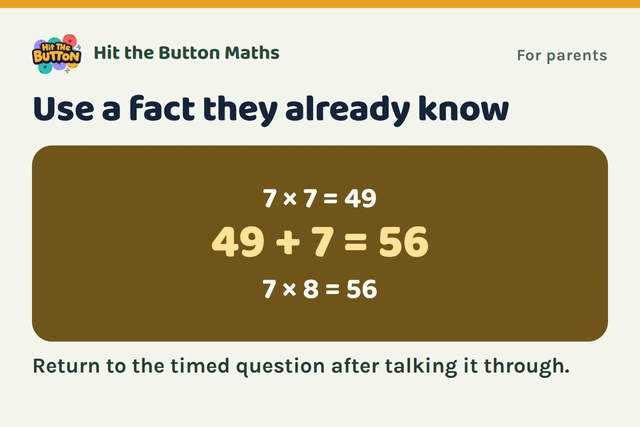
If the teacher identifies a difficult table, start with one table in an untimed round. Ask the child to explain one answer before adding a timer.
If your child is anxious about it
Some children do pick up on test-like language from older siblings, friends, or overheard conversations, and arrive at the check more worried than the format actually warrants. If you notice this:
- Reassure them explicitly that there's no pass or fail — this is worth saying more than once, since a single reassurance often doesn't fully land against a build-up of anxiety.
- Let them try a practice round on our MTC practice mode once, so the actual format (25 questions, a few seconds each) is familiar rather than imagined as something scarier.
- Avoid repeated practice right before the check itself — one calm, confidence-building round a few days out is better than daily drilling in the final week.
- If anxiety seems to be building well beyond what the situation calls for, it's worth a quiet word with the class teacher, who will have seen this before and can usually adjust how the check is introduced to that child specifically.
Questions parents ask
Will my child know their MTC score straight away?
Not usually on the screen. Schools receive the results and decide how, or whether, to share individual scores with parents — some send them home, some mention them at parents' evening, some don't routinely share the raw number at all. If you want to know, the most reliable way is to ask your child's teacher directly.
What if my child gets a low score?
It isn't a fail, there's no pass mark, and it doesn't affect any qualification. A low score just tells the school which specific times tables need more practice, the same way a spelling test flags specific words. Treat it as a to-do list, not a verdict.
Can my child resit the check if they do badly?
Ask your child’s school about the statutory arrangements if a check was missed or interrupted. At home pupils can replay this practice activity as often as they wish.