Hit the Button Square Numbers
Practise square numbers with quick-fire questions. Choose Easy, Medium or Hard and try to beat your score.
2² to 20² — press to start

Square numbers from 2² to 20²
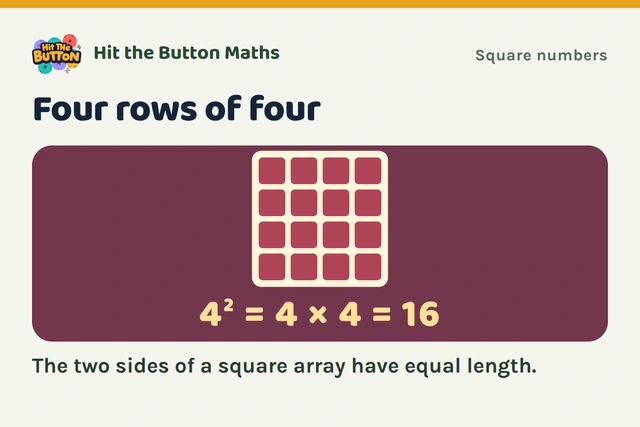
A square number is a number multiplied by itself — 5² (5 squared) is 5 × 5 = 25. Square numbers usually appear in Year 5 and 6 as part of the National Curriculum's work on multiplication, and they come up again quickly in secondary maths (area, algebra, Pythagoras), so early fluency pays off well beyond primary school.
How this connects to times tables
Every square number is really just a times-tables fact in disguise — 7² is the same recall as 7 × 7 from the times tables grid. Children who are already fluent in their times tables up to 12 usually pick up square numbers quickly; this mode exists mainly to make that specific pattern automatic on its own.
Squares 2² to 20², worked out
Swipe sideways to see the full table on a small screen.
| n | n² | n | n² |
|---|---|---|---|
| 2² | 4 | 12² | 144 |
| 3² | 9 | 13² | 169 |
| 4² | 16 | 14² | 196 |
| 5² | 25 | 15² | 225 |
| 6² | 36 | 16² | 256 |
| 7² | 49 | 17² | 289 |
| 8² | 64 | 18² | 324 |
| 9² | 81 | 19² | 361 |
| 10² | 100 | 20² | 400 |
| 11² | 121 |
Why squares show up in area
A square number is literally the area of a square with sides of that length — 5² = 25 is the number of unit squares that fit inside a 5-by-5 square. This is usually the first time children meet the idea that multiplication can represent a physical area rather than just "groups of," which is worth pointing out explicitly since it's a concept that gets reused constantly from here on: rectangles, later algebra, and eventually geometry.
Square roots — the reverse question
If 6² = 36, then the square root of 36 is 6 — the number that, multiplied by itself, gives that total. This game only asks the forward direction (n² = ?), which is the Year 5–6 expectation; square roots as a named concept usually come slightly later, but a child who's fluent in squares forwards tends to pick up roots quickly, since it's the same fact recalled in reverse.